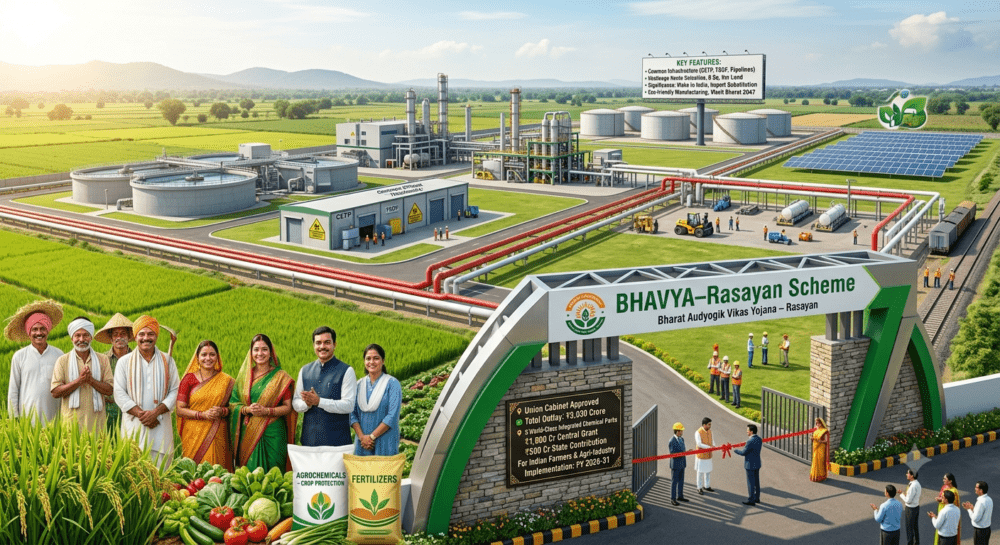
In a major move toward sustainable agriculture, the Union Cabinet has approved the Bharat Audyogik Vikas Yojana – Rasayan (BHAVYA–Rasayan) scheme.
Although BHAVYA–Rasayan is designed as an industrial manufacturing initiative, its core objective directly impacts the agricultural supply chain. Specifically, by establishing world-class chemical manufacturing parks across India, the scheme aims to lower raw material import costs. Consequently, this will help stabilize local prices for fertilizers and agrochemicals while promoting eco-friendly industrial practices.
Therefore, understanding this scheme is crucial for modern agriculture. Here is a comprehensive breakdown of the BHAVYA–Rasayan Scheme and what it means for Indian farmers.
What is the BHAVYA–Rasayan Scheme?
The BHAVYA–Rasayan Scheme is a Central Sector Scheme implemented by the Department of Chemicals & Petrochemicals under the Ministry of Chemicals & Fertilizers.
With a total outlay of ₹3,030 crore, the scheme focuses on creating three integrated, world-class chemical manufacturing parks. These hubs will be developed across selected states over a 5-year period between FY 2026–27 and FY 2030–31.
Key Scheme Specifications:
- Total Outlay: ₹3,030 Crore (₹3,000 Crore allocated for infrastructure and utilities, whereas ₹30 Crore is designated for administrative expenditure).
- Funding Structure: Up to ₹1,000 crore central grant per park, along with a minimum ₹500 crore contribution from the host State Government.
- Selection Mechanism: Furthermore, candidate states will be selected through a competitive Challenge Route.
- Land Requirement: Minimum 8 sq. km. (2,000 acres) of contiguous, encumbrance-free land per project.
4 Direct Benefits for the Agricultural Sector
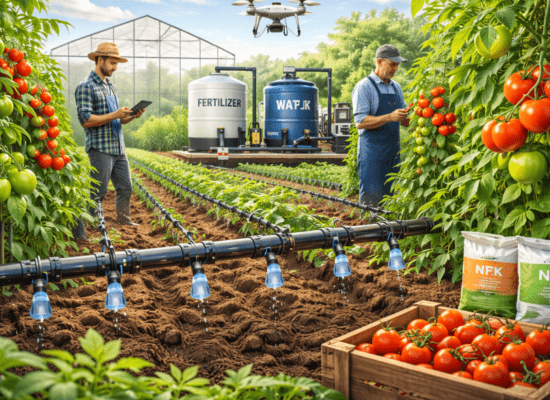
Modern farming relies heavily on quality chemical inputs—ranging from crop protection sprays to drip irrigation pipes. Fortunately, BHAVYA–Rasayan addresses current supply chain bottlenecks to deliver four major advantages:
1. Affordable Agrochemicals & Crop Protection
Currently, India imports significant quantities of active technical ingredients used to produce insecticides, fungicides, and herbicides. As a result, international price surges directly inflate retail input costs for farmers. However, localizing raw chemical manufacturing drastically lowers production overheads. Consequently, this ensures stable and fair pricing for crop protection products.
2. Strengthened Domestic Fertilizer Supply
In addition, these specialized chemical parks will streamline the processing of basic chemical compounds. Thus, manufacturers can easily produce custom micronutrient blends and soil enrichment solutions locally.
3. Lower Costs for Farm Infrastructure & Plastics
Petrochemical polymers are essential for manufacturing drip irrigation tubing, mulching films, and greenhouse sheeting. Because domestic petrochemical capacity will expand under this scheme, essential smart irrigation tools will become far more affordable over time.
4. Eco-Friendly Manufacturing & Clean Water Safeguards
Moreover, the scheme mandates high-tech, centralized environmental facilities within each park. Therefore, nearby agricultural lands and groundwater sources will remain fully protected from harmful industrial runoff.
Infrastructure Highlights: Built for Sustainability
Each BHAVYA–Rasayan chemical park will feature shared, state-of-the-art utility infrastructure, including:
- CETP (Common Effluent Treatment Plant): A shared facility designed to treat industrial wastewater before safe release into the environment.
- TSDF (Treatment, Storage & Disposal Facility): Dedicated infrastructure built specifically for the scientific and safe management of hazardous industrial waste.
- Solvent Recovery & Distillation Plants: High-tech systems installed to recycle and reuse chemical solvents efficiently.
- Logistics & Pipeline Networks: Centralized steam distribution, specialized industrial pipelines, and modern warehousing designed to minimize operational handling costs.
Summary Key Takeaways for Farmers
| Feature | Details | Direct Farm Benefit |
| Budget Allocation | ₹3,030 Crore | Upgraded domestic supply chain for agro-inputs |
| Project Target | 3 Integrated Chemical Hubs | Guaranteed local availability of raw chemical ingredients |
| Environmental Focus | Mandatory CETP & TSDF Facilities | Total protection of surrounding soil and groundwater quality |
| Long-Term Vision | Make in India & Viksit Bharat @2047 | Reduced dependence on costly imported fertilizers and sprays |