
Indian agriculture is standing at the edge of a technological revolution. Rising labor shortages, increasing farming costs, climate uncertainty, and the need for precision are pushing farmers to look beyond traditional machinery. One of the most talked-about innovations today is self-driving tractors—machines that can operate with minimal or no human involvement.
At AspaGrow, we closely track emerging agricultural technologies to help farmers understand whether these innovations are practical, affordable, and beneficial in real farming conditions. In this blog, we explore whether self-driving tractors are truly ready for Indian farms.
What Are Self-Driving Tractors?
Self-driving tractors, also known as autonomous tractors, are advanced farm machines that use GPS, sensors, artificial intelligence (AI), cameras, and software to perform farming operations automatically. These tractors can plough, sow, spray, and even harvest without continuous human control.
Farmers can monitor and control these tractors through mobile apps or digital dashboards, making farming more precise and efficient.
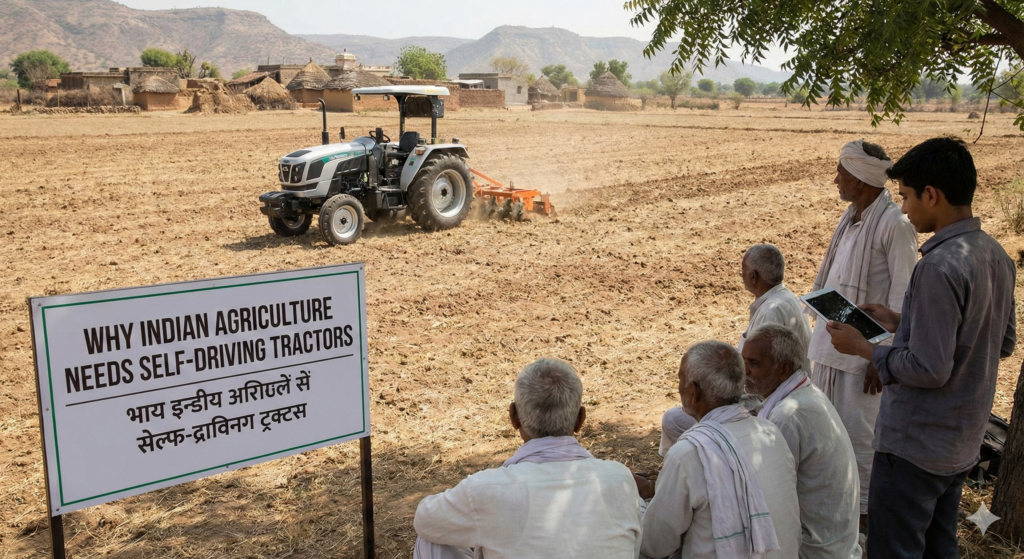
Why Indian Agriculture Needs Self-Driving Tractors
Indian farming faces unique challenges:
- Shortage of skilled labor
- Rising labor wages
- Small landholdings
- Delays in sowing and harvesting
- Climate unpredictability
Self-driving tractors can address many of these issues by ensuring timely operations, accuracy, and consistency, which are critical for crop productivity.
How Self-Driving Tractors Work
Self-driving tractors rely on multiple technologies working together:
- GPS & RTK Systems for accurate navigation
- AI & Machine Learning to adapt to field conditions
- Sensors & Cameras to detect obstacles and crop rows
- Autonomous Software for decision-making
These systems allow tractors to follow predefined paths with extreme precision, reducing overlaps and input wastage.
Key Benefits of Self-Driving Tractors for Indian Farmers
1. Solves Labor Shortage
Self-driving tractors reduce dependency on human labor, especially during peak seasons like sowing and harvesting.
2. Improves Productivity
Autonomous machines can work longer hours with consistent performance, increasing farm productivity.
3. Precision Farming Support
Accurate seed placement, fertilizer application, and spraying reduce wastage and improve crop health.
4. Long-Term Cost Savings
Though expensive initially, self-driving tractors reduce fuel use, labor costs, and operational inefficiencies over time.
5. Climate-Smart Farming
Optimized routes and reduced emissions support sustainable and climate-smart agriculture.
At AspaGrow, we believe precision and efficiency are key to future farming success.
Challenges of Self-Driving Tractors in India
Despite their advantages, several challenges remain:
- High initial cost
- Limited awareness among farmers
- Small and fragmented landholdings
- Need for technical training
- Internet and GPS connectivity issues in rural areas
However, with government support, rental models, and awareness platforms like AspaGrow, adoption barriers can be reduced.
Are Self-Driving Tractors Suitable for Small Farmers?
This is the most common question. While buying an autonomous tractor may not be feasible for small farmers today, rented self-driving tractors and custom hiring centers make this technology accessible.
Shared usage models allow farmers to benefit from advanced machinery without heavy investment.
Role of Government and Agri-Tech Companies
Governments and agri-tech companies are investing in:
- Smart agriculture programs
- Farm mechanization subsidies
- Digital farming infrastructure
As these initiatives grow, self-driving tractors will become more affordable and practical for Indian agriculture.
Future of Self-Driving Tractors in India
The future looks promising. As technology becomes affordable and adapted to Indian conditions, self-driving tractors will likely:
- Support precision farming
- Reduce farmer workload
- Improve yields
- Encourage sustainable agriculture
At AspaGrow, we see autonomous machinery as a key pillar of future-ready farming.
FAQ | Self-Driving Tractors
Q1. What are self-driving tractors and how do they work in farming?
Self-driving tractors are autonomous agricultural machines designed to perform farming tasks without continuous human control. They work using a combination of GPS technology, sensors, cameras, artificial intelligence, and software systems. These technologies help the tractor navigate fields accurately, avoid obstacles, and perform operations like ploughing, sowing, spraying, and harvesting with high precision. In farming, self-driving tractors reduce manual effort, improve accuracy, and ensure timely operations, which directly supports higher productivity and better farm management.
Q2. Are self-driving tractors suitable for Indian farming conditions?
Yes, self-driving tractors are gradually becoming suitable for Indian farming conditions, especially for medium and large farms. While challenges like small landholdings, uneven fields, and connectivity issues exist, manufacturers are developing models adapted to Indian terrain. With improvements in GPS accuracy, sensor technology, and localized software, autonomous tractors are being tested successfully in Indian fields. As awareness, training, and infrastructure improve, self-driving tractors will become more practical across different regions of India.
Q3. Can small and marginal farmers use self-driving tractors?
Small and marginal farmers may find it difficult to purchase self-driving tractors due to high initial costs. However, they can still benefit from this technology through rental services, cooperative farming models, and custom hiring centers. These shared-use options allow farmers to access autonomous machinery during critical farming stages without heavy investment. Over time, as costs reduce and government support increases, self-driving tractors will become more accessible even for small farmers.
Q4. Do self-driving tractors really help in increasing crop productivity?
Yes, self-driving tractors significantly help in increasing crop productivity. By performing tasks with precision and consistency, these tractors ensure accurate seed placement, proper fertilizer application, and timely operations. This reduces input wastage and improves crop health. Since autonomous tractors can operate for longer hours without fatigue, they help farmers complete farming activities at the right time, which plays a crucial role in improving overall crop yield and quality.
Q5. How does AspaGrow support farmers in understanding self-driving tractors?
AspaGrow supports farmers by providing easy-to-understand information about self-driving tractors and other modern farm machinery through blogs, guides, and educational content. The platform explains both benefits and challenges, helping farmers make informed decisions before adopting new technology. By spreading awareness about autonomous farming solutions, AspaGrow helps farmers prepare for future-ready agriculture and adopt innovations in a practical and cost-effective manner.
Conclusion
Self-driving tractors are no longer a distant dream. While challenges exist, the benefits they offer—efficiency, precision, cost savings, and sustainability—make them a powerful solution for modern agriculture. With gradual adoption, rental models, and proper training, self-driving tractors can transform Indian farming.
Platforms like AspaGrow play an important role in educating farmers about such innovations and helping them prepare for the future of agriculture.