
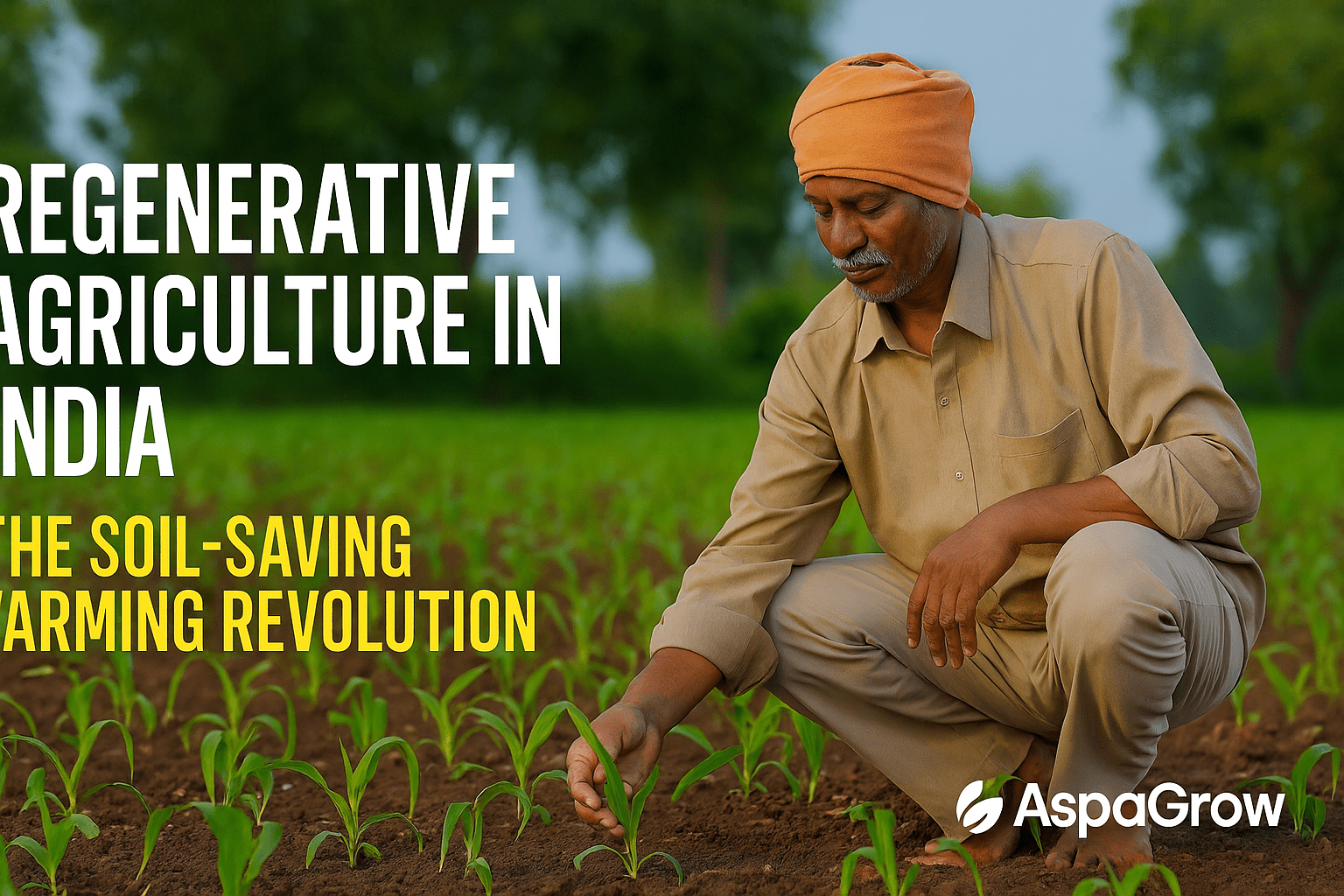
India’s farming system is going through a massive shift. With declining soil fertility, unpredictable weather, overuse of chemicals, and increasing production costs, farmers are searching for sustainable methods that protect the soil and increase long-term profits. One powerful approach gaining global attention is Regenerative Agriculture — a holistic method of farming that heals the soil instead of harming it.
Regenerative agriculture focuses on rebuilding soil organic matter, increasing biodiversity, improving water retention, and restoring natural ecosystems. Unlike traditional methods, this system is centered around working with nature instead of against it. AspaGrow believes regenerative agriculture is one of the most important farming movements that will shape India’s agricultural future.
What Is Regenerative Agriculture?
Regenerative agriculture is a farming method that restores soil health by improving biodiversity, increasing organic matter, and promoting natural ecological processes. It is not just about reducing chemical use — it is about bringing life back into the soil.
It includes practices that enhance soil structure, reduce erosion, increase water-holding capacity, and make crops more resilient. AspaGrow supports regenerative agriculture because it helps farmers reduce costs while boosting long-term productivity.

Why Regenerative Agriculture Matters in India
India is facing one of the biggest soil crises in the world. More than 30% of agricultural land is degraded, and poor soil quality is leading to declining yields, increased pest attacks, and higher chemical dependency. Farmers spend more money each year just to maintain the same yield level.
Regenerative agriculture is essential because it:
- Reduces fertilizer dependency
- Restores natural soil fertility
- Increases long-term productivity
- Protects crops against extreme climate
- Improves profitability through lower input costs
AspaGrow emphasizes that soil is not a resource that can be replaced — it must be rebuilt, and regenerative agriculture is the path forward.
Key Principles of Regenerative Agriculture
1. Minimal Soil Disturbance (Low or No Tillage)
Turning the soil frequently kills microbes and reduces organic matter. Regenerative farming encourages minimum tillage, which maintains soil structure and prevents erosion.
AspaGrow trains farmers on low-tillage practices to maintain maximum microbial activity in fields.
2. Continuous Soil Cover
Bare soil loses nutrients faster. Regenerative agriculture promotes cover crops like cowpea, mustard, dhaincha, or legumes that protect soil from sunlight, wind, and erosion.
Cover crops also reduce weeds and add nitrogen naturally.
3. Crop Rotation and Mixed Cropping
Growing the same crop repeatedly drains soil nutrients and encourages pests. Crop rotation rejuvenates the soil and prevents pest cycles.
Mixed cropping — such as maize + beans — increases biodiversity, reduces pest spread, and improves yields.
4. Increasing Organic Matter
Organic matter is the heart of healthy soil. It improves water absorption, fertility, and microbial activity.
Farmers use compost, farmyard manure, green manure, and bio-fertilizers to increase soil carbon levels. AspaGrow promotes natural soil boosters that enhance long-term fertility.
5. Integrating Livestock
Animals bring natural balance to farming. Their manure enriches the soil, while grazing helps manage cover crops.
Many Indian farmers already practice mixed farming — regenerative agriculture strengthens this system.
6. Reducing Chemical Inputs
Regenerative farmers gradually reduce:
- Synthetic fertilizers
- Pesticides
- Herbicides
Natural pest management, biological inputs, and organic fertilizers keep the ecosystem healthy.
AspaGrow helps farmers shift from chemical dependency to sustainable alternatives.
How Regenerative Agriculture Helps Farmers
✔ Better Soil Health
Healthier soil means stronger roots, better nutrient absorption, and disease-resistant crops.
✔ Lower Input Costs
Chemical costs decrease significantly when soil fertility improves naturally.
✔ Higher Water Savings
Regenerative soils hold more water, reducing irrigation requirements by up to 40%.
✔ Better Yields Over Time
While chemical farming gives short-term gains, regenerative agriculture improves yields steadily over years.
✔ Climate Resilience
Healthy soils protect crops from droughts, floods, and extreme heat — something India urgently needs.
Top Regenerative Farming Techniques Used in India
1. Zero Budget Natural Farming (ZBNF)
Founded by Subhash Palekar, ZBNF promotes natural inputs like jeevamrut, beejamrut, and mulching. Many Indian states have adopted this method.
2. Mulching
Mulch protects soil from heat, reduces evaporation, and adds organic matter. Farmers use:
- Straw
- Coconut husk
- Dry leaves
- Grass
3. Jeevamrut & Organic Bio-Ferments
These natural bio-fertilizers restore microbial life and accelerate nutrient cycling.
4. Cover Cropping
Cover crops like legumes enrich nitrogen and reduce weeds.
5. Agroforestry
Combining trees with crops increases shade, preserves moisture, and enhances biodiversity. Mango, moringa, neem, and bamboo are popular choices in Indian agroforestry.
6. Composting & Vermicomposting
These methods convert organic waste into nutrient-rich soil amendments.
AspaGrow encourages farmers to create their own compost to reduce external input costs.
How to Start Regenerative Farming: A Beginner’s Guide
1️⃣ Assess Your Soil Health
Check pH, organic matter, and soil life. AspaGrow offers simple soil testing guidance for farmers.
2️⃣ Reduce Chemical Usage Gradually
Avoid stopping chemicals suddenly. Reduce them slowly while increasing natural inputs.
3️⃣ Introduce Cover Crops
Start with easy options like cowpea or mustard.
4️⃣ Adopt Mulching
Mulching is one of the easiest regenerative techniques to begin with.
5️⃣ Prepare Natural Fertilizers
Compost, jeevamrut, and vermicompost boost soil fertility.
6️⃣ Rotate Crops Every Season
Rotating crops improves soil nutrients and reduces disease pressure.
7️⃣ Integrate Livestock if Possible
Even a few goats or cows can contribute to healthier soil cycles.
Is Regenerative Farming Profitable?
Yes — especially in the long run.
Farmers save money on fertilizers, pesticides, and irrigation. Profits increase as soil fertility improves naturally. Many regenerative farmers also earn more by selling organic produce at premium rates.
AspaGrow has seen farmers reduce input costs by 40–60% within three years of adopting regenerative methods.
Success Stories from Indian Farmers
- Farmers in Andhra Pradesh adopting ZBNF have doubled yields in several crops.
- Maharashtra farmers using mulching and drip irrigation have cut water use by 50%.
- Punjab farmers transitioning to regenerative wheat and paddy have reduced chemical use significantly.
AspaGrow works closely with such farmers to document results, spread awareness, and promote sustainable practices.
FAQs
1. What is regenerative agriculture in simple words?
It is a farming method that improves soil health by using natural processes like mulching, cover crops, and compost instead of chemicals.
2. Is regenerative farming expensive to start?
No. Most practices like mulching, composting, and crop rotation are low-cost. AspaGrow helps farmers adopt these methods easily.
3. Can regenerative farming increase productivity?
Yes. It improves soil fertility, water retention, and plant health, leading to better yields over time.
4. How long does it take to see results?
Farmers usually see improvement within 1–2 seasons. Soil health continues to grow each year
5. Does regenerative farming work for all crops?
Yes. It is suitable for fruits, vegetables, grains, pulses, and even orchards.
Conclusion
Regenerative agriculture is more than a technique — it is a movement that brings soil back to life. At a time when India is battling soil degradation, climate stress, and high farming costs, regenerative agriculture provides a clear, sustainable path forward.
AspaGrow believes that the future of Indian agriculture lies in healthy soils, natural inputs, biodiversity, and long-term resilience. By adopting regenerative practices, farmers can increase yields, reduce costs, and create healthier farms for future generations.
The soil gives us life — and now it’s our turn to give life back to the soil.



One thought on “Regenerative Agriculture in India: The Soil-Saving Farming Revolution”
Comments are closed.